
Bishop’s Waltham Palace — A Medieval Bishop’s Residence
Explore a 12th–14th Century Palace Ruin with Moat and Grounds Winchester Road, Bishop’s Waltham, Hampshire, SO32 1DN
Call us anytime +44 370 333 1181
https://www.english-heritage.org.uk/visit/places/bishops-waltham-palace/
Open during daylight hours
Email: customers@english-heritage.org.uk

Specification
Outdoor PicnicA Palace Built for Power, Comfort, and Administration
In Bishop’s Waltham, the palace ruins sit beside calm public grounds and a surviving moat.
Bishops built the palace to manage estates, host officials, and support church work.
Today, the stone walls, earthworks, and water defences remain easy to explore.
It’s a compact but impressive medieval ruin.
Origins in the 1100s
Bishop Henry of Blois began major building work in the 12th century.
Later bishops expanded the complex for residence and administration.
Therefore, the palace shows both early Norman planning and later medieval upgrades.
The original complex included:
Great hall and service ranges
Private bishop’s chambers
Moat for defence and status
Gatehouse and inner courtyards
In addition, the palace managed large rural estates around Hampshire.
Expansion in the 1200s and 1300s
Later bishops added stone rooms, arcades, and layout changes.
These improvements made the palace more practical and more formal.
Moreover, the 14th-century works reflect England’s shift to fortified residences for bishops and nobles.
Visitors can still trace:
Room outlines
Window arches
Stair areas
Wall foundations
Moat edges
Furthermore, the long building footprint shows the scale of the former precinct.
Exploring Bishop’s Waltham Palace
1. The Moat
Water still surrounds parts of the perimeter.
It signals the palace’s defensive and ceremonial role.
In addition, the moat walk is level and easy to follow.
2. The Great Hall Range
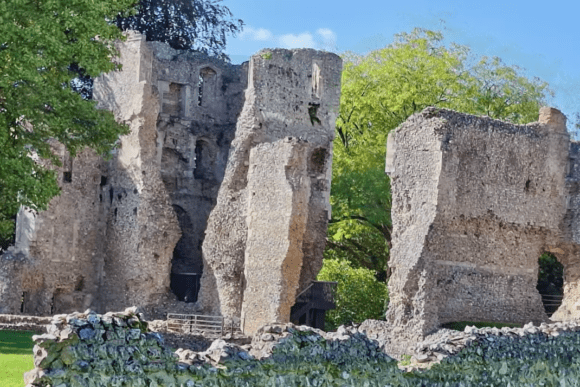
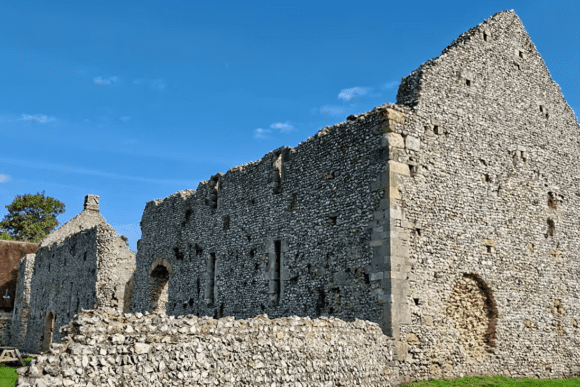
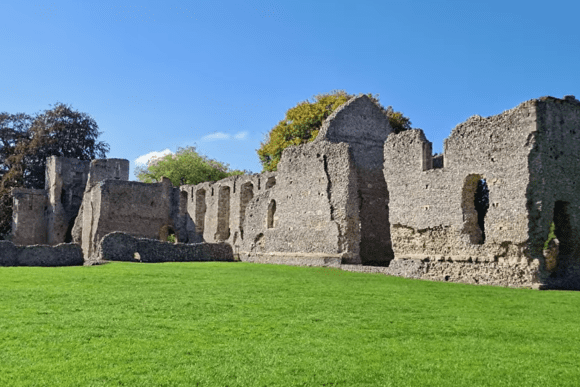
High stone walls outline the main hall.
Arches and window lines remain visible.
Moreover, this area shows how large gatherings once took place.
3. The Bishop’s Rooms
Roofless chambers reveal fireplace framing and doorway lines.
These remains show private living spaces.
Furthermore, stone details help explain room functions.
4. The Grounds
Open grass surrounds the ruins for short, steady walking.
This space gives clear sight lines for photography.
Because the site is central, it’s easy to combine with town walks.
(Learn more at the English Heritage listing for Bishop’s Waltham Palace.)
Visiting Bishop’s Waltham Palace
How to Get There
Location: Bishop’s Waltham, Hampshire, England
Parking: Town car parks and street spaces nearby
Train: Nearest main station at Botley or Southampton (bus/taxi onward)
Bus: Local routes to Bishop’s Waltham town centre
Opening Hours & Admission
Open daily for outdoor exploring
Free entry
Facilities
No café or toilets inside the site
Town services nearby
Mostly level paths
Nearby Attractions
Bishop’s Waltham Museum — Local heritage displays
Waltham Chase Woods — Rural walking areas
River Hamble Trails — Riverside paths nearby
Winchester — Cathedral city within reach
Together, these stops form the Hampshire Medieval Heritage Trail.
Why Visit Bishop’s Waltham Palace?
The site offers:
Clear medieval planning
Moat and water defences
Tall stone hall walls
Calm open-air access
Whether you enjoy archaeology, short town walks, or medieval buildings, the palace gives a clear and quiet visit.
It’s not just ruins — it’s a medieval estate centre preserved beside the town green.
No Reviews